Reading the paragraph on the left demonstrates the power of the human mind. The reading process consists of turning symbols into concepts. This demonstration points out that the process of "reading" works in ways that may not be obvious.
For another non-obvious example of how the reading process works, consider this... Reading faster and with better fluency can result in better comprehension.
The average adult reading speed is between 200 and 300 words per minute. Proficient readers can easily read two and three times that speed with good comprehension. Many people are proficient readers. Learning how to be a proficient reader can be learned if you have the desire.
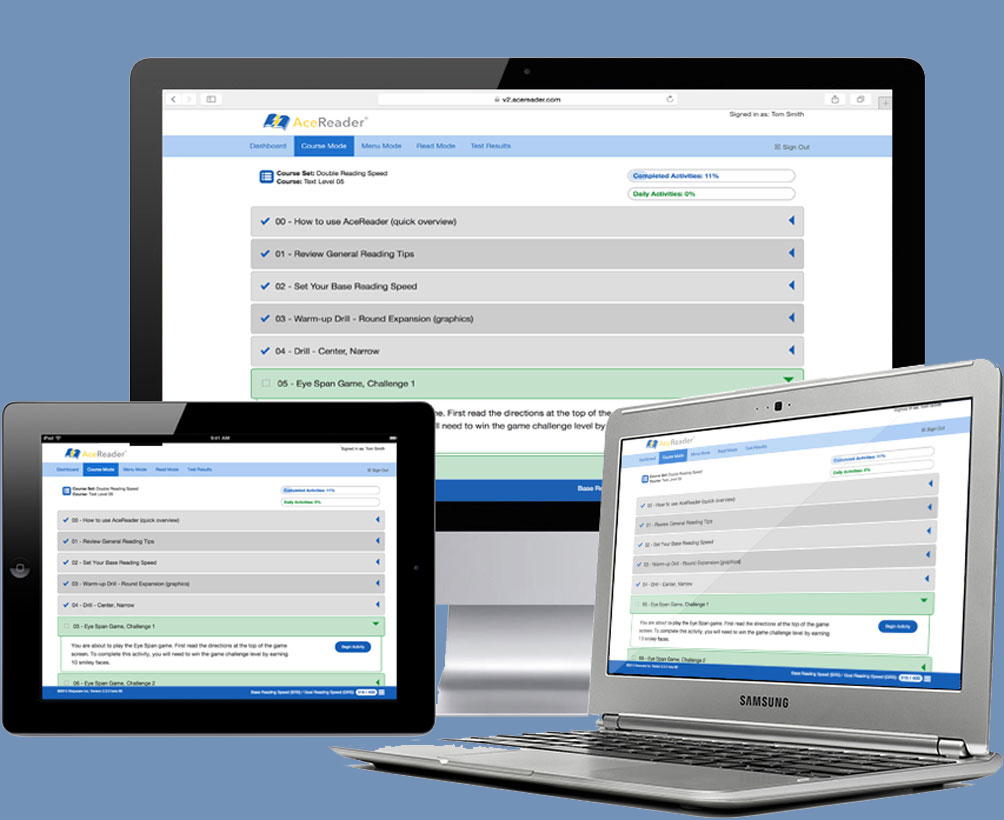
AceReader can help you increase your reading speed and fluency. The learning process does take effort and the winning formula for success is positive attitude, patience and practice. AceReader makes practicing fun and easy with it's automated self-adjusting course that walks you through the training process.
Students can significantly cut their study time. It may boost your career by giving you that needed edge. You may actually find yourself enjoying to read.
Click here to take a free reading test to determine your reading speed.
Here at StepWare, we often get asked "How fast should my child be reading at his or her current grade level?" The question is a good one, but it's important to realize there are a number of factors that influence the answer. Different research studies measure reading fluency differently and may include some or all of the following: word count, number of different words, number of low- and/or high-frequency words, sentence length and complexity, print size, illustrative support, and topic familiarity. The best approach is to evaluate all the data and arrive at a composite answer.
WPM = Words per minute. A standard word, as described by Carver (1990), contains six letter spaces -- letters, punctuation, and spacing. Fluency in this context is determined by silent, not oral reading.
The chart below represents a compilation of such data, taken from the following sources -- Carver (1990), Mather and Goldstein (2001) (reported in LD Online), and Rasinski (reported on the ReadingA-Z.com Web site):
| Grade Level | Average Reading Speed (WPM) | Optimal Reading Speed (WPM) |
|---|---|---|
| 1 | 95 | 143 |
| 2 | 105 | 158 |
| 3 | 120 | 180 |
| 4 | 145 | 218 |
| 5 | 160 | 240 |
| 6 | 180 | 270 |
| 7 | 191 | 287 |
| 8 | 205 | 308 |
| 9 | 219 | 329 |
| 10 | 233 | 350 |
| 11 | 247 | 371 |
| 12 | 261 | 392 |
| Adult | 200-250 | 400-750 |
*The non-adult figures represent a 50% increase in the average reading rate at each level. Adults can often double to triple their baseline reading rates with training and continued practice, either on recreational or work-related materials. These figures are the opinions of StepWare, Inc., based on an evaluation of the literature and an assessment of clients' average results.
Do you think that reading is important? Most people do, but they don't necessarily understand just how important it can be.
Consider this: According to the National Literacy Council's 1998 report, the adult illiteracy rate in the United States at that time was 38.4% that's greater than one-third of the American adult population! And these low reading proficiency results correlated strongly with both high unemployment rates and high poverty levels 43% in the case of the latter.
And this is not a problem that is going to go away. While 75% of today's jobs require a minimum ninth-grade reading proficiency level, almost 20% of the workers can't read above the fifth-grade level. That makes them unable to find jobs that provide adequate pay.
These literacy numbers translate into consequences for both institutions and individuals. High schools and universities must spend more money and time training students who can't read well enough to function at the upper levels. Employers must compensate for the workers' lack of basic skills by increasing spending on training and hiring additional personnel. And workers lose pay and benefits because they can't adequately perform the tasks they are given, even something as simple as a set of written instructions. The U.S. Education Department's data show that only seven percent of full-time workers who performed at below basic levels on reading tests earned $850 to $1,149 a week, while a full 20 percent of workers who had scored at proficient levels earned such wages.
In 1979, a college graduate's weekly earnings were 31 percent greater than the weekly earnings of a high school graduate. By the early 1990s, this disparity had grown, with the weekly earnings premium for college graduates 53 percent higher than their lesser-read peers1. But despite attempts to strengthen reading and comprehension in the classroom, many students continue to fall behind.
It's not all doom and gloom, though. Many people believe that because they have not performed well in the past, they can't learn to do any better. This is simply not true. Reading is a series of skills, and they can be taught to any person at any age; all that is required is that you be willing to put in the time and the effort to master the techniques.
Not only will these techniques give you better performance on the job and a larger paycheck, but they can give you a better quality of life overall, as your reading, comprehension, and longterm retention grow year after year. You'll have more hours during the day to do what you want because you'll be able to move through what you need (or want) to read more quickly.
How can you accomplish this transformation? Some common ways of gaining reading skills are to hire a tutor, to take advantage of workforce development programs (sponsored by your company or by an educational institution such as a community college), to take an on-site or online reading and/or speed reading class, or to use a software program such as AceReader that will guide you through the steps of becoming a better reader.
Remember: Proficient Reading = Proficient Learning. Once you unlock your reading potential, you will unlock your ability to learn everything more proficiently. So go for it! You have everything to gain and nothing to lose. You, too, can be a better, and more rewarded, reader.
1Race, Cognitive Ability and Wage Inequality Journal article by Patrick L. Mason; Challenge, Vol. 41, 1998.
Mention the words "speed reading" to most people, and what you'll get in response is a long list of why speed reading is not really reading and why its techniques can't possibly work. However, the truth of the matter is that this list is nothing more than a collection of myths, and it is not at all accurate.
According to the Web site Dictionary.com, the word "read" comes from the Old English verb "raedan," which meant "to advise or to interpret something written." It can now be explained as looking at something carefully so as to understand the meaning of the symbols (i.e. the letters, words, etc.) it contains. Since interpretation of the symbols is what allows us to derive meaning from the visual images, it follows that reading is not just a visual, but also a cognitive skill, and, therefore, one that can be learned.
Let's look at some of the most prominent speed reading myths:
Myth:
Speed reading is a gimmick.
Reality:
Speed reading is a series of skills that can be learned by anyone who is willing to put in the time and effort to do so.
Myth:
A person can be too young/old to learn how to speed read.
Reality:
Since speed reading is a series of skills, it follows that they can be learned. Students should begin the process only after they have mastered how to decode language (approximately 7-8 years old, or 3rd to 4th grade). Adults may have to unlearn a lifetime's accumulation of bad reading habits, but once they've done so, all that's required is that they put in the time to learn the new techniques.
Myth:
Quick eye movements can make you a better reader.
Reality:
Speed is only valuable if you understand what you're reading, so just because you can move your eyes quickly, it does not make you a speed reader. You need to increase your speed by doing it in a way that ensures you increase your comprehension, as well, such as increasing your visual field (the horizontal and vertical range you can see). This field is also known as your eye span.
Myth:
When you speed read, you simply skip over every second or third word, and therefore miss material.
Reality:
Speed readers do not skip over words, even the small ones, since they are important to the flow and comprehension of the material.
Myth:
Speed reading is nothing more than skimming, scanning, and key-wording.
Reality:
People do not use the above techniques to learn how to speed read. They use them as tools that allow them, once they are speed readers, to meet a specific purpose in reading a text. These tools allow them to select particular phrases, images, symbols, etc. to help determine whether they need to read further. If they do, then they should move at best possible speed over the material while noting everything, including all the letters and punctuation marks.
Myth:
Fast readers lose comprehension, and slow readers gain comprehension.
Reality:
In fact, the reverse is true. The myth arose because most commercial programs focus solely on speed, as this is the easier of the two techniques to master and the students can see positive results fairly quickly as a result. If they don't see a quick, increase, they often believe they have failed and do not continue. Remember, though, that speed reading is a skill and must be learned over a period of time. It is also important to understand that an increase in reading speed will always precede a person's increase in comprehension. Like driving a car, you only became fluent moving and stopping the car after you've learned the individual components (i.e. brakes, clutch, accelerator, etc.). The same is true if you examine text letter-by-letter or word-byword; you can't focus on the bigger picture (i.e. the story, the article, the blog, etc.), and you miss information. If you read more at a time and at higher speeds, you can understand and appreciate more of what the author has to say.
Myth:
Speed reading only works on certain types of reading material.
Reality:
If something is written, it can be speed read. It is important to understand, though, that a speed reader varies the rate of speed depending on the type of material, the familiarity with the text, and a variety of other factors.
One final note: If you'd like to learn how to speed read, there are three main avenues you can explore. The first is an on-site (regular or traditional) classroom, with books and a live instructor. The second is an online program, hosted by a company on their or a third party's Web site. And the third is a reading efficiency software program such as Ace Reader Pro, that you could use to help with your computer and overall reading at home or at work. Whichever way you go, just remember - with a positive attitude and a desire to learn, you, too, can become a speed reader.
How we read is almost as important as what we read. While most people adjust the seat, steering wheel and mirrors in their cars, they fail to take the same consideration when they sit with a book, or more and more with a computer screen. Below are a few suggestions on how you can optimize your environment and your endurance with a few simple steps.
The AceReader Pro Reading Efficiency software offers the following simple steps:
We often think of reading as an automatic, static process; however, that is not the case. No matter what our age or current reading level, we can learn new techniques for reading in general or on specific types of material. Below are a number of different techniques and strategies that can help make you a better, more efficient reader, no matter what you read.
Three common and related techniques are skimming, scanning, and previewing. None of these are mechanisms of reading; rather, they are tools that readers can use to help improve both their speed and comprehension of written material.
Skimming is the technique you use when you want to rapidly identify the main idea or ideas in the passage. For example, most people don't read every word of the newspaper. Instead, they quickly look at the headlines, flip through the pages and stop only when something catches their eye that they want to read in more depth. At a rate of three to four times faster than their normal rate of speed, people often skim when they have a lot of material to read in a limited amount of time and want to know where they should concentrate their attention.
Scanning is the technique you use when you want to find a particular letter, word, symbol, etc., or if you're looking for a specific book chapter or section. You do not read the text, you simply move your eyes quickly over the material, searching for the item you want; as soon as you find it, you stop. You do not have any comprehension of the material, but you understand when you begin that all you want is the item you've selected; anything else is superfluous. If you need to understand the material, you'll have to go back and read it from the beginning.
Previewing is probably the most important of the techniques, and in many ways it is similar to skimming. Previewing gives you a sense of the material - such as topic, level of difficulty, author's style and length - before you actually sit down to read it. It allows you to decide whether or not you want or need to spend the time reading the entire passage to obtain more of the details. Because you have a "heads up" on the material you're about to read, you move through it much more quickly and efficiently than if you had not previewed it.
Here are some of the steps you can take to preview effectively:
You should preview everything you read, regardless of its complexity or length. Here are some suggestions for previewing different types of material:
The best strategy you can do to improve your reading, though, is to read, anything and everything. And if you want to practice reading effectively from a computer, you can use any number of software programs, such as the AceReader Pro, or Amby's Education site: http://amby.com/educate/reading.html, which provides vocabulary and word development activities. They will help you make the transition from reading on paper to reading off of a screen.
Reading proficiency is a critical skill for any standardized test, whether it's the SAT, the LSAT, the GMAT, the GRE, the MCAT, or any other similarly formatted assessment. However, its importance exceeds mastering just the "Critical Reading" or "Reading Comprehension" sections. Many students have difficulty with all portions of the tests, either because they read too slowly to complete the questions on time, or they try to race through the material but don't comprehend what they've just read. They therefore can't answer the questions correctly. Whether verbal or math assessments, all contain passages of some sort that ask you to read the material, comprehend its content, and then answer questions related to both presentation and content.
The question is, how do you become a better reader? The College Board, (www.collegeboard.org), the organization that administers the SAT and other standardized tests, recommends that you start by reading anything and everything you can, broadening your scope to include a wide range of subjects and styles, including fiction, personal narrative, ethnic (art, music, history), literary criticism, humanities (music, drama, dance), and a variety of the sciences and social sciences. Plan to spend at least 20-30 minutes per day. You should also increase your vocabulary, either by using standard lists of words or by looking up words you don't know and can't get from their context (the text around them).
While much of your reading will be paper-based, in our technologically burgeoning society, you also need to learn how to read efficiently from a computer. Some assessments have converted to computer-based administration only, and on-screen reading proficiency is absolutely essential as a result.
One way to accomplish proficiency in all media is to use a reading efficiency software program, such as AceReader Pro, to supplement your paper-based work. The software allows you to read set passages (with comprehension tests) or import your own material, pace yourself while reading the material, read for comprehension, and adjust how the material is presented (i.e. one word at a time, whole sentences at a time, highlighted, etc.). You can gradually push both your speed and your comprehension to high enough rates that you can read through any standardized test with speed, efficiency, and accuracy.
You can also, using the Deluxe versions, create additional Tests, Drills, and Games to target your reading strengths and shore up your weaknesses, and you can import documents, such as vocabulary lists or material from the College Board Web site, specific to the standardized test you will be taking. That will help you move through the exam quickly and efficiently, as you will already be comfortable and familiar with the material.
Below are a few specific tips on how to approach a standardized test once you've become an efficient reader:
We all know people who seem knowledgeable about so many things. Have you ever wondered, how these people got so smart? Most people are not born smart. Over their lives, they accumulate knowledge, which Wiki defines to be "the awareness of facts, truths, or information gained." A knowledgable person is therefore one who has been exposed to words, facts, ideas, and opinions, but who has not necessarily put this information to use.
Wisdom, or "smarts" as we sometimes call it, is defined by the Random House Dictionary as a person "having the power to discern and judge properly as to what is true or right," or to discriminate between good and evil, significant and trivial. In other words, a smart person can take the factual knowledge, put it into context, and behave in an appropriate manner as a result. Some of this ability is no doubt due to physiological or genetic factors, but a large percentage can be learned - that's right, you can learn to be smart. But how?
It's important to note that most "smart" people are bibliophiles (book lovers), and they read voraciously, at many different levels and on a wide range of topics. Thomas Carlysle described it well when he said, "What we become depends on what we read after all the professors are finished with us. The greatest university of all is the collection of books."
That's not such an outlandish idea. Reading exposes us to new ideas and perspectives, shows us how people behave in a variety of situations, and presents multiple scenarios for each situation's resolution. We can step back, examine, and extrapolate from each single view to apply, in whole or in part, judgments to other situations in our lives. Many major medical and scientific breakthroughs have resulted from an individual's ability to create order from chaos.
Yet, despite the importance of reading, the adult illiteracy rate in the United States stands at a staggering 38.4% -- more than one-third of the population, and according to statistics reported by the National Institute for Literacy (1998):
And it's not just individual status or achievement that's at risk. According to Carol Morris of the Charlotte-Mecklenburg Workforce Development Board, "American businesses are estimated to lose over $60 billion in productivity each year due to employees' lack of basic skills." Many employers find themselves saddled with the need for remedial training, just to bring their employees up to a minimum functional level.
What can we do to reverse this trend? What can we do to become smart? Not surprisingly, we can start by implementing constant and proper reading habits. Reis, et al (Using Enrichment Reading Practices to Increase Reading Fluency, Comprehension, and Attitudes, posted 22 May 2008) observed that for many years, educators and researchers have demonstrated the relationship between improved reading comprehension and higher scholastic achievement. With that achievement, comes greater income, and with greater income comes greater productivity, no matter what the job. And you'll have fun while you're doing it, visiting places and people, and sharing ideas that you'd never encounter otherwise.
One great way to get yourself to become a reader is to use a reading software program, such as the AceReader Pro. All the material is grade-leveled (Levels 1-12 + adult), so each person can work through it at his or her own pace. At the lower levels, the program focuses on recognizing "sight words," developing vocabulary, and using the Reading Comprehension Tests to put the words in context. The upper levels focus on learning to comprehend more complex ideas by pushing students to read and comprehend more at a time. As the user works through the Tests, Drills, and Games, he or she picks up facts and the ability to connect one fact to another. Reading becomes exciting, interesting, and fun.
Reading - it's a smart thing to do.
Articles created for StepWare, Inc. as joint collaborative effort between StepWare, Inc. and Bumbershoot, Inc.
Copyright © StepWare Inc., All Rights Reserved
http://www.stepware.com
http://www.acereader.com
http://www.bumbershootwriting.com